

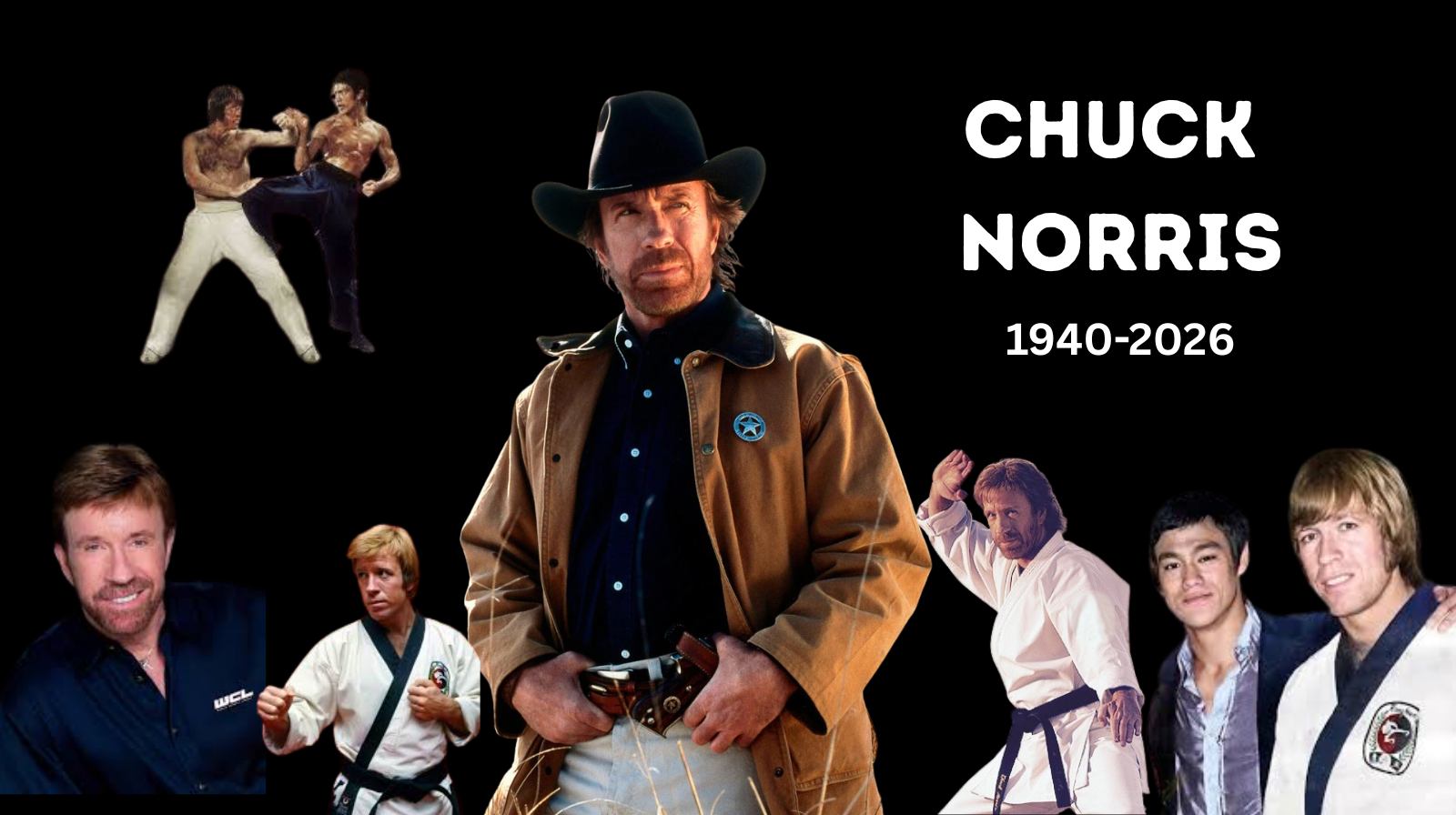
March 10, 1940 – March 19, 2026
A Tribute to His Life, His Discipline, and His Enduring Legacy in the Martial Arts
There are figures who participate in an industry. Then there are figures who build one. Chuck Norris belongs to the second category. His death on March 19, 2026 at the age of 86 closed the life of a man who had already secured his place as one of the most influential forces in the history of the martial arts.
His family released a statement the following morning that captured both the man and the mission.
“To the world, he was a martial artist, actor, and a symbol of strength. To us, he was a devoted husband, a loving father and grandfather, an incredible brother, and the heart of our family.”
— The Norris Family | March 20, 2026
CNN, NPR, CBN News, the Associated Press, Wikipedia, and the Norris family statement on Instagram all verify every fact in this tribute. His military history, competitive record, and organizational achievements carry documentation across each of those independent sources.
Multiple independent major media organizations confirmed his passing within hours of the family announcement. Beyond that, the family requested privacy during their period of grief and that request is honored throughout this article.
For every school owner, instructor, and student who has ever stepped onto a mat, his story carries direct relevance. This article is not an obituary. It is a tribute to what he built. As a result, it traces his Chuck Norris martial arts legacy from a struggling household in Oklahoma through competitive championships, system creation, global media, philanthropy, and institutional governance. Every phase of that journey left a permanent mark on the industry he loved.
What follows is a chronological record of contribution. It traces his impact across competition, instruction, system design, media, philanthropy, and the business of martial arts. In short, it is the story of a man who refused to stop building.
— The Timeline —
Carlos Ray Norris arrived on March 10, 1940 in Ryan, Oklahoma. Financial hardship defined the household from the start. His father struggled with alcoholism and eventually left the family. Still, his mother raised him with faith and consistency in circumstances that offered neither stability nor direction.
He grew up as shy, introverted, and without early athletic distinction. Nothing in his childhood pointed toward future dominance. Yet that outcome did not come from favorable conditions. He built it in opposition to every disadvantage his early years presented.
In 1958, Norris enlisted in the United States Air Force. For the first time in his life, structure, accountability, and expectation became part of his daily existence. So was the discipline that had been absent throughout his childhood. His deployment to Osan Air Base in South Korea would prove to be the most critical turning point of his entire development.
While stationed there he began training in Tang Soo Do. This was not casual exposure. Full immersion into a traditional system built on hierarchy, repetition, and deep respect for the instructors defined his experience completely. However, the physical results were secondary to what happened internally. He later reflected that martial arts strengthened him mentally, psychologically, and emotionally in ways no other experience had reached.
Foundation Moment: The Tang Soo Do training Norris received in South Korea did not just teach him to fight. It gave him the first identity framework his life had ever offered. That framework became the engine behind everything that followed.
Norris received his discharge from the Air Force in August 1962 with the rank of airman first class. He returned to the United States and immediately continued training. He opened a martial arts studio in Torrance, California and so began a competitive career that would reshape the American karate circuit.
His entry into competitive karate was not triumphant. He lost his first two bouts to Joe Lewis and Allen Steen. Those defeats were not indications of a ceiling, however. They carried the full cost of the education he had chosen to pursue. His response to losing was to train harder and compete again.
By 1967 the compounding of disciplined work produced results no one could ignore. He won the karate tournament that year defeating seven consecutive opponents. His final victory came over Skipper Mullins. As a result, that performance announced his arrival among the elite of American karate in a way that could not be disputed.
He went on to become a six-time undefeated World Professional Middleweight Karate champion. No competitor of that era matched his record for sustained consistency at the championship level. In contrast to many fighters of his era, his style did not rely on power. He relied instead on timing, control, and precision. Those qualities reflected exactly what Tang Soo Do had taught him to prioritize.
Championship Record: Six-time undefeated World Professional Middleweight Karate Champion. His first tournament victory came in 1967 after defeating seven consecutive opponents in a single event.
His relationship with Bruce Lee became one of the most documented partnerships in martial arts history. They trained together beginning in the mid-1960s and developed a genuine mutual respect rooted in shared commitment to excellence. In addition, Lee later invited Norris to appear in The Way of the Dragon in 1972. That film introduced a global mainstream audience to what a trained practitioner actually looked like in motion.
Lee challenged every serious practitioner of that era to question fixed systems and prioritize functional application. However, Norris did not abandon his traditional foundation. He refined it instead. He retained what had produced results and evolved what needed evolution. As a result, that philosophy of principled adaptation became the operational approach behind everything he would later build.
Most martial artists of his generation focused entirely on their own training and competitive performance. Chuck Norris made a different decision instead. He focused on creating a framework that others could inherit, certify under, and teach with consistency across different schools and different regions. Because of this, his influence extended far beyond any single dojo or any single generation of students.
Chun Kuk Do integrated karate, taekwondo, and practical application into a unified framework with a structured belt progression, an instructor certification process, and a formal ethical code. Those three components working together transformed individual mastery into a transferable system. That is the distinction between a practitioner and a builder. Norris was both and so he chose to be remembered as the latter.
The system gave future instructors a clear curriculum. Students gained a defined path with visible milestones. Therefore schools gained a retention structure built directly into the methodology itself rather than invented by each owner individually. That architectural choice is what allows a martial art to survive its founder. Because of this, Chun Kuk Do is surviving his.
System Architecture: Chun Kuk Do included structured belt progression, instructor certification, and a formal ethical code. These three components made the system transferable across schools, regions, and generations without losing consistency.
Steve McQueen suggested he take acting seriously. Norris did. His film career produced more than 20 titles over two decades including Breaker Breaker, Missing in Action, Code of Silence, Lone Wolf McQuade, and The Delta Force. He built each role on the same foundation: discipline, controlled response, and moral clarity expressed through physical action.
However, the cultural contribution of those films extended far beyond entertainment revenue. For example, for millions of viewers across the United States, Canada, and internationally, his roles provided the first sustained demonstration of what a trained martial artist looked and moved like in real situations. That exposure built cultural credibility for the entire industry in communities that had never set foot inside a dojo.
From 1993 to 2001, Chuck Norris played Cordell Walker in Walker Texas Ranger. The show ran for eight seasons on CBS and attracted an audience that reached far beyond the martial arts community. In contrast to tournament formats that required prior knowledge to appreciate, the show required nothing except a willingness to watch a man who operated with principle in every situation.
The character he built on screen reflected the same values traditional martial arts instruction develops in students at every level. The show did not present discipline, controlled response, and accountability as athletic traits. Instead it framed them as a complete philosophy for living. For many school owners currently running programs, that show delivered the first consistent external evidence that what they taught carried value far beyond the mat.
Walker Texas Ranger generated more than 200 episodes and became one of the most watched dramas on American television during its run. Beyond that, it built an entire generation of cultural trust in what the martial arts represent as a lasting institution.
Cultural Reach: Walker Texas Ranger aired for eight seasons from 1993 to 2001 on CBS. It remains one of the most sustained demonstrations of martial arts values ever delivered to a mainstream television audience.
In 1992, Norris established the United Fighting Arts Federation to provide governance, standards, and consistency across schools and instructors operating under his system. The Federation was not a ceremonial organization. It functioned as an active institution designed to ensure that what instructors taught in one school aligned with what they taught in another.
That governance structure reflects a business principle every school owner who wants to grow understands: consistency requires systems not personalities. Norris therefore built the system so the standard would outlast any individual instructor including himself.
In 2005, Chuck Norris founded the World Combat League with a clear objective: modernize and commercialize martial arts competition for a mainstream audience. Traditional tournament formats were fragmented and difficult for non-practitioners to follow as paying spectators.
His answer was a team-based competition model that ran on city-based teams, head-to-head matchups, and a continuous action scoring system. That format mirrored professional sports leagues in a way no martial arts organization had previously attempted. Beyond that, it introduced athlete branding and professional production values as core requirements rather than optional additions.
The league did not achieve long-term market dominance. However, its strategic contribution remained significant regardless of that commercial outcome. For instance, it proved that martial arts competition could reach a broad audience when properly packaged. It demonstrated that discipline and entertainment were not competing values. As a result, those conclusions continue to shape how the industry approaches audience development today.
Through Kickstart Kids, Chuck Norris brought martial arts instruction directly into public school classrooms across Texas. The program placed trained instructors inside schools in underserved communities. Its goal was not to produce competitive champions. It aimed to produce disciplined and accountable young people.
The program pursued character development, personal responsibility, and self-respect as its measurable outcomes. In addition, independent assessments documented improvements in school attendance, academic performance, and disciplinary records among participating students. Those results held across multiple school environments and proved repeatable.
More importantly, that is the deepest institutional legacy of Chuck Norris. Not the box office totals. Not the championship titles. The recognition that martial arts serves as a vehicle for human development and the decision to build a program that delivered that outcome at scale in communities that needed it most. Every instructor who teaches character alongside technique today carries that same work forward.
Kickstart Kids Legacy: The program brought certified martial arts instruction into Texas public schools in underserved communities. Documented outcomes included improvements in attendance, academic performance, and disciplinary records across participating student populations.
Chuck Norris understood that discipline and principle could translate into business as clearly as they translate into physical practice. For example, his long-running partnership with Total Gym demonstrated that the same focus and credibility he built in the martial arts could generate trust with a mass market audience in an entirely different category.
That business translation did not happen by accident. In fact, it grew as the natural extension of a career that had always treated discipline as an operating system rather than a sport-specific trait. His willingness to build institutions, brands, and commercial ventures from the same foundation that built his competitive career separated him from every other martial artist of his era.
With that in mind, school owners who run their programs as genuine businesses rather than hobbies are operating from that same principle. The mat is where the product gets delivered. The business model is how it survives long enough to matter.
Chuck Norris spoke openly about his Christian faith across his entire public career. After acknowledging that professional success had pulled him away from what genuinely mattered, he came to a committed relationship with Christ as an adult. That return to faith alongside his wife Gena became the foundation of the second chapter of his personal life and the explicit values framework behind Kickstart Kids and his public advocacy.
He told CBN News: “People come up to me and say, ‘Chuck, you’re the luckiest guy in the world.’ When they say this to me, I kind of smile because luck had nothing to do with it. God had everything to do with it.”
He never compartmentalized his faith. It showed up in how he taught, how he built, and how he led. For that reason, the most enduring systems he created rested explicitly on a code of ethics and a stated commitment to human dignity. As a result, those values did not appear in his work by accident. They served as the foundation by deliberate design.
Rocky Catala never met Chuck Norris. That remains one of the genuine professional regrets of his career. Not because of celebrity. Because of what Norris represented as a builder of systems and a keeper of standards in an industry that needs more of both.
The influence began through film and through Walker Texas Ranger long before the martial arts business became Rocky’s professional focus. In other words, it was not entertainment in the conventional sense. It was repeated demonstration of how a martial artist carries himself in the world beyond competition. That standard became part of the foundation for how Rocky built Black Belt Membership Software and how he approaches the martial arts school business today.
Norris proved that discipline could be institutional. He proved it could outlast any single practitioner. Beyond that, it transfers through systems, curricula, and consistent standards applied across generations. Ultimately, the work Rocky does every day with school owners across the United States, Canada, and Puerto Rico grows from that same conviction.
Chuck Norris lived 86 years. He spent most of them building things that would outlast him. He passed on March 19, 2026 surrounded by his family and at peace. Ten days earlier he had posted a birthday video on Instagram while training in Hawaii saying he felt vibrant and grateful.
He was a martial artist first. Then a champion. Then a builder. Then an institution. At every stage he returned to the same source: the discipline he found on a Korean air base at the age of eighteen that told him repetition and respect still produce results.
“He lived his life with faith, purpose, and an unwavering commitment to the people he loved. Through his work, discipline, and kindness, he inspired millions around the world and left a lasting impact on so many lives.”
— The Norris Family | March 20, 2026
That statement is not a eulogy. It is a job description. The martial arts industry still has work to do. And the standard he set for how that work gets done is still standing.
Rest well, Mr. Norris. The dojo is still open.
Chuck Norris built systems because he understood that a practitioner without structure produces results only for themselves. A system produces results for every student who walks through the door for the next fifty years. So the question every school owner faces is the same one he always asked: does the structure on the mat today reflect the level of discipline the students deserve?
If managing that structure by hand pulls attention away from the work that actually matters then martial arts management software like Black Belt Membership Software exists to take that weight off the desk. Rocky built it for school owners who take the business as seriously as they take the instruction. Visit blackbeltcrm.com to see how it works. Schedule a demo today with Rocky Catala and find out what the right system can do for your school.
See how Black Belt Membership can assists you. To manager your growing martial arts business.