

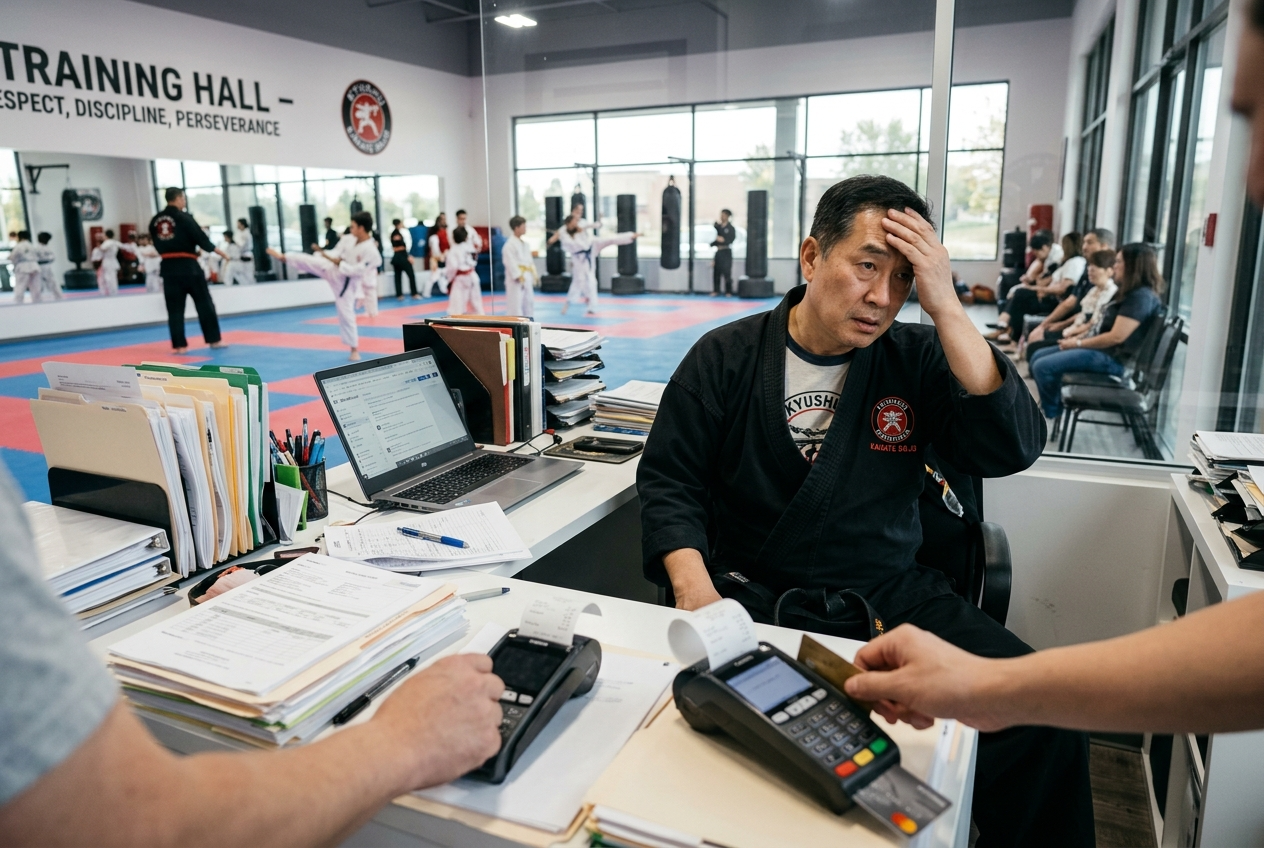
Probably yes, if billing takes staff hours every week, members disappear without anyone catching the warning signs, and pulling a clean revenue number still requires a spreadsheet and an afternoon. Schools usually cross that line somewhere in the 100 to 200 active student range. At 80 students the old setup holds together. At 180 it starts breaking in ways that cost real money. This article walks through three signs your current martial arts software has become the bottleneck and shows what changes when a school moves to a system actually built for the work.
You did not sign the lease to live behind a desk. You opened the school to teach and to build something that lasts past your career. So when collections drift and members vanish without a phone call, the right question stops being whether your team can put in more hours. The right question is whether the tools you bought three years ago can still hold the school you run today.
Rocky Catala has logged more than 35 years on the mat and behind the desk. He holds a sixth-degree black belt in Goju-Ryu Karate-do and trains in Brazilian Jiu-Jitsu. He owned and operated his own school. Since 2011 he has worked directly with hundreds of school owners across the United States, Canada, and Puerto Rico, rebuilding billing systems and retention numbers from the inside.
Every pattern in this article comes out of those rooms. The ranges reflect what actually shows up in real schools across regions and sizes. Where the data is fuzzy or the school is sensitive about its numbers, that gets said plainly instead of dressed up in fake precision.
Black Belt Membership has been running daily operations for hundreds of martial arts schools since 2011. The features described below were built around real owner problems brought into real planning meetings.
Billing should be the quietest part of the operation. In most schools that have outgrown their software it is the loudest. Staff log in every Monday to push charges through. They chase three or four late accounts by phone on Tuesday. They re-enter card numbers by hand whenever a member’s bank reissues plastic. None of that work makes the school better. It just keeps the lights on.
The cost of doing it manually shows up in two places. The first is staff time. Fifteen hours a week buried in billing admin is fifteen hours nobody spent on the floor or in front of a prospect. The second is leakage. A school of 150 active members at a five percent late-payment rate is sitting on thousands of dollars per month that never make it into the bank account. Most owners do not see the full size of that gap until someone pulls the books apart line by line.
Working harder will not fix the leak. Putting a system between the failed charge and the lost dollar will. Strong billing software handles credit cards and electronic checks under one roof. It retries failed charges several times across a few days before bothering anyone on staff. It pulls fresh card numbers from the Visa and Mastercard account updater services the moment a member’s card gets reissued. In schools that switch from manual to automated billing, collection rates typically climb from the low eighties into the mid to high nineties inside sixty to ninety days. That is real money, recovered from the back door.
A member skips Monday. They are gone again the following Monday. By the third miss they have already written the cancellation note in their head and not one person on the team knew anything was wrong. The gap between that second missed class and the cancellation email is exactly where retention is won or lost. Most schools lose it because the gap is invisible.
Paper sign-in sheets cannot flag a pattern. A spreadsheet that nobody opens until the cancellation arrives cannot flag a pattern either. Both are storage, not alert systems. Real attendance tracking flags consecutive absences and pushes a same-week notification to the instructor or owner. The check-in happens while the student is still inside the decision, not after the decision has been made.
The other place students slip through is the lifecycle gap. Every student walks the same arc. Trial class. Enrollment. First stripe. Belt test. Rank advancement. Eventually black belt. When attendance lives in one tool, billing in another, and rank history in a third, the student profile is split across systems that do not talk to each other. Promotion readiness gets missed. Stripes get awarded late. Parents stop feeling like the school knows their child. That is how retention drifts in schools where instruction is sharp and culture is solid. The teaching is fine. The data underneath the teaching is broken.
Most schools that have outgrown their software are running on a stack rather than a system. One subscription for billing. A second for scheduling. A third for email and lead follow-up. Maybe a fourth for attendance. The owner is writing checks every month for software that still leaves the front desk apologizing to members about information the school should already have on file.
The case for consolidating is not the dollars saved on subscriptions. Those are small. The case is what the team stops doing. Staff stop guessing. They stop hunting across three tabs for a member’s last belt test date. They stop re-entering the same name and email in three different systems. They stop building workarounds for features that should already exist. Belt testing schedules, promotion ceremonies, and curriculum tracking are not standard inside fitness software. If the platform was designed for gyms or yoga studios, the team is quietly inventing workarounds for those gaps every single week.
The other thing consolidation buys is visibility. Clean reporting brings monthly recurring revenue, new enrollments, cancellations, and class attendance averages onto one screen. That is the difference between a gut feeling and a decision backed by what the school actually produced last month. Without that screen, an owner is making calls on a six-week delay. By the time the trend is obvious, it has already cost real money.
Here is a composite drawn from real patterns. No specific school is named because the shape of the change matters more than any single example.
The school sits at roughly 200 active members. The owner has been in business six or seven years. Instruction is strong. Culture is strong. The schedule is full. Behind the scenes, the operation runs on three or four disconnected tools and somewhere around fifteen hours a week of administrative work that should not require a human at all.
Collection rates land in the low to mid eighties. That number is normal for manually managed billing and it is also a five-figure annual revenue gap that nobody is tracking. Lead follow-up happens when staff remember. Attendance lives on paper or in a spreadsheet that nobody opens until a cancellation lands in the inbox.
Schools matching this pattern that move to one consolidated martial arts management platform see two changes first. Collection rates climb into the mid to high nineties inside sixty to ninety days because failed cards retry on their own instead of churning silently. Cancellation rates drop in that same window because the team finally catches the second missed class the day it happens rather than the week the cancellation arrives. Owner hours on administrative work fall by roughly half. Most owners spend the recovered time teaching more, recruiting better instructors, or finally taking a day off without flinching. Revenue becomes predictable. Growth becomes plannable.
The exact figures shift from school to school. The shape of the change does not.
Most martial arts schools in 2026 are still running on systems that were never built for them. The cost shows up monthly in missed payments, dropped members, and hours buried inside work the platform was supposed to handle. More effort is not the answer. A better system is.
When billing runs without supervision and the team catches the attendance drop on the day it happens and every member record sits in one profile, the owner’s role changes. You stop reacting to fires and start leading the school. Retention climbs because awareness climbed first. Revenue stabilizes because collections stabilized first.
That is the job strong martial arts software is built to do. Not someday. This quarter.
If tracking these numbers by hand is costing you time then Martial Arts Software Like Black Belt Membership Software can do that work for you. Visit blackbeltcrm.com to see how it works. Schedule a Demo Today with Rocky Catala and find out what the right system can do for your school.


See how Black Belt Membership can assists you. To manager your growing martial arts business.