

Running an MMA gym means wearing a lot of hats, and member management is often the one that fits the worst. Between tracking attendance, chasing overdue payments, and trying to keep members engaged enough to renew, many owners feel stretched thin before the day even begins. The good news is that the right systems and tools can transform those daily friction points into smooth, automated workflows that free you to focus on coaching. This guide breaks down exactly how to assess your gym’s needs, choose the right tools, build strong communication workflows, and track the metrics that drive real growth.
| Point | Details |
|---|---|
| Identify key management needs | Understanding your gym’s specific requirements helps build efficient systems for member tracking and engagement. |
| Leverage software for automation | Modern tools streamline billing, attendance, and communication, freeing up staff time and reducing mistakes. |
| Engage members with structured workflows | Effective communication drives retention, builds community, and keeps your gym thriving. |
| Track and improve retention metrics | Regularly monitor attendance, promotions, and feedback to spot trends and act quickly for improvement. |
| Move beyond manual habits | Automation and engagement strategies unlock sustainable growth that traditional management can’t match. |
Before you can fix a problem, you need to name it clearly. Most MMA gym owners face a consistent set of management challenges: spotty attendance tracking, late or missed payments, and inconsistent communication that leaves members feeling disconnected. These issues do not just create administrative headaches. They directly erode your retention rate and your bottom line.
Start by listing the core requirements your gym actually needs from a management system. Think about:
The gap between what you need and what you currently have tells you exactly where to start. Many gym owners underestimate the student retention cost of losing even a handful of members per quarter, which can add up to thousands of dollars in lost lifetime value annually.
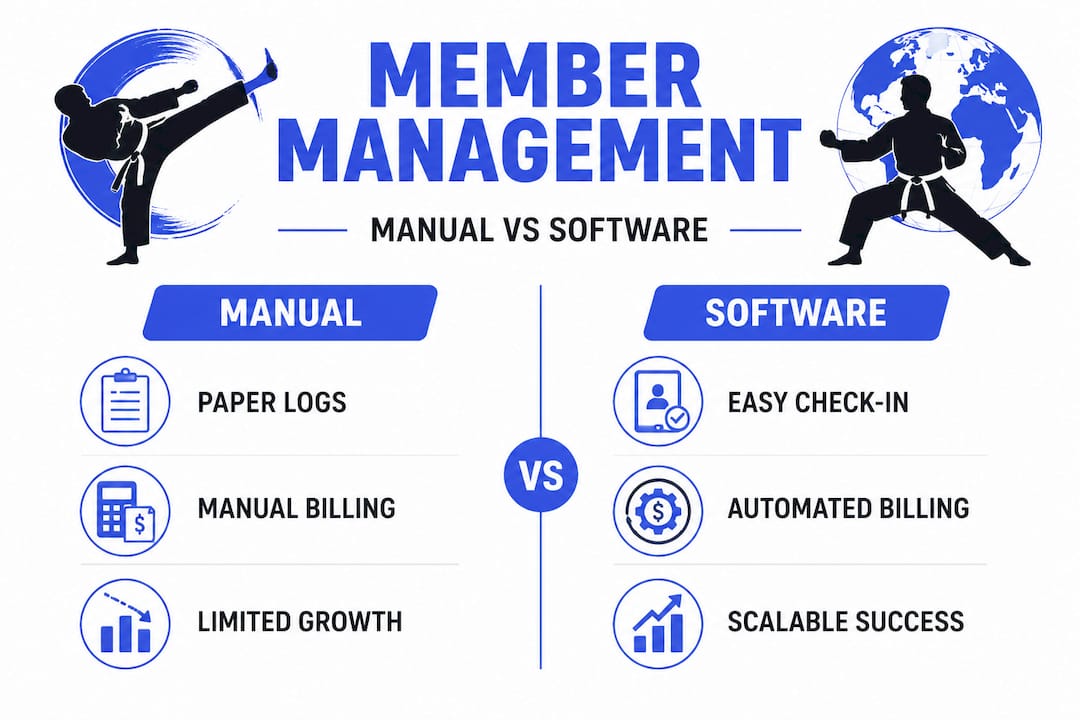
Here is a quick comparison of manual management versus software-based management to put the stakes in perspective:
| Factor | Manual management | Software-based management |
|---|---|---|
| Attendance tracking | Paper logs, prone to errors | Digital, real-time, automated |
| Billing | Manual invoicing, easy to miss | Automated recurring payments |
| Member communication | Ad hoc emails or calls | Scheduled email and SMS campaigns |
| Retention tracking | Guesswork and gut feel | Data-driven alerts and reports |
| Time investment | High (10+ hours/week) | Low (under 2 hours/week) |
| Scalability | Limited, breaks under growth | Designed to scale with you |
Manual systems might feel manageable when you have 30 members. By the time you hit 100 or more, the cracks become crises. Effective improving student retention starts the moment you commit to tracking the right data consistently. Think of your member management system as the foundation of everything else you build. Without it, even the best marketing or media campaign strategies will struggle to produce lasting growth.
Once you have mapped out your gym’s needs, the next step is choosing the tools that will actually meet them. The market offers three broad options: manual tracking, general spreadsheets, and specialized gym management software. Each has trade-offs worth understanding.
| Tool type | Best for | Limitations |
|---|---|---|
| Paper and manual logs | Very small gyms, under 20 members | No automation, no analytics, high error rate |
| Spreadsheets (Excel, Google Sheets) | Basic tracking on a tight budget | Time-intensive, difficult to scale, no reminders |
| Specialized gym software | Growing gyms, 30 or more members | Requires onboarding, monthly subscription cost |
Choosing the right fit is not just about budget. It is about your growth trajectory. If you are planning to add a second location, launch new program tiers, or grow past 50 active members, software vs. spreadsheets is not really a question worth debating for long. Software wins at scale, every time.
Here is a step-by-step process for evaluating which tool is right for your gym right now:
Automated billing streamlines financial processes and boosts retention by removing the awkward payment conversations and dramatically reducing late or missed dues. For boxing gym management software and similar combat sports facilities, the right platform will also handle multi-tier memberships and class scheduling in one place. The billing and automation features in a purpose-built platform go far beyond what any spreadsheet can replicate.
Pro Tip: Start your automation journey with billing and digital attendance before tackling communication tools. These two areas deliver the fastest and most measurable return on your investment.
Communication is the heartbeat of member retention. When members feel informed and included, they show up more consistently and renew more reliably. When they feel forgotten, they drift away quietly until one day their membership just lapses.
The types of communication your members actually appreciate fall into a few clear categories:
Each of these touchpoints strengthens the member’s sense of belonging. Structured engagement campaign ideas can be adapted from broader fitness marketing approaches, but the key is personalization. A message that says “Hey [Name], we missed you in class this week” hits differently than a generic blast.
“Retention rises when gyms use structured communication workflows.” Gyms that implement consistent, automated outreach see measurable improvements in member attendance and renewal rates compared to those relying on manual, ad hoc messages.
Setting up these workflows does not require a marketing degree. With the right software, you can schedule a re-engagement email to fire automatically after a member misses three consecutive classes, or trigger a congratulations message the day a belt promotion is logged. Even yoga management software platforms demonstrate that consistent digital touchpoints drive retention across fitness disciplines, not just combat sports gyms.
Pro Tip: Automate class reminders and event invitations to run on a fixed schedule. Even simple, well-timed messages increase class attendance by reducing the “I forgot” factor that keeps committed members away.
For gyms ready to take the next step, exploring membership demo and pricing options gives you a clear picture of what a fully integrated communication system actually looks like in practice.
You cannot manage what you do not measure. This is especially true in an MMA gym where member progress is both physical and emotional. Tracking the right metrics gives you early warning signs of churn and clear evidence of what is working.
The metrics every gym owner should be monitoring regularly include:
Tracking attendance, belt progression, and retention metrics is vital for growth, and the gyms that do it consistently outperform those that rely on instinct alone. Data removes the guesswork and points you directly at the levers that matter.
Here is a practical numbered process for building your tracking system:
Your monthly data review should prompt action on a few key insights:
Strong belt progression and retention data shows that members who advance through belt ranks consistently are far less likely to cancel than those who feel stagnant. The retention blueprint approach of reviewing member progress every 90 days gives you a structured rhythm for catching problems early and celebrating wins loudly.

Key stat: Gyms that implement structured tracking and review processes report retention improvements of 15 to 30 percent within the first year compared to those using informal, manual methods.
Here is an opinion that might rub some traditionalists the wrong way: the biggest threat to your gym’s growth is not competition from the school down the street. It is your attachment to doing things the way you have always done them.
Many experienced gym owners carry a quiet pride in managing everything personally. They know every member by name, handle billing one invoice at a time, and send reminders through text messages on their personal phone. That personal touch is genuinely valuable. But it does not scale, and it costs you more than you realize.
The cost of losing students is not just the monthly dues. It is the lifetime value of a committed member who might have trained for years, referred friends, and become part of your community. When manual processes cause a billing error or a missed re-engagement message, that member’s decision to leave often has nothing to do with your instruction quality. It is an operational failure, not a coaching failure.
High-retention gyms we have observed over many years share a consistent pattern. They automate the routine so they can be fully present for the meaningful. Billing runs on schedule. Reminders go out automatically. Reports generate themselves. That frees the owner and head instructor to focus on what no software can replace: building genuine relationships on the mat.
The argument that “we are a community gym, not a corporate chain” is real and worth honoring. But automation does not strip community out of your gym. It gives you more time to build it. When you are not chasing invoices at 10pm or manually updating spreadsheets on a Sunday morning, you have the energy to actually show up for your members in ways that matter.
The training academy growth guide shows clearly that the gyms growing fastest are the ones combining strong coaching culture with smart operational systems. Both matter. One without the other leaves real potential on the table.
If this guide has shown you anything, it is that the gap between where your gym is now and where it could be often comes down to systems, not effort. You are already putting in the work. The right tools simply make that work count for more.

Black Belt Membership Software was built specifically for martial arts school owners who want to stop managing spreadsheets and start building lasting communities. From automated billing features that eliminate payment headaches to communication tools that keep members engaged between classes, the platform handles the back-office work so you can focus on the mat. Explore the studio transformation tips that gyms like yours have already used to grow, or learn more about simplifying membership management with automation. Get started today and see how much more you can accomplish when your systems work as hard as you do.
Specialized membership management software can automate billing and help reduce errors, saving significant time for staff and owners while improving payment consistency.
Track attendance, belt progression, payment history, and event participation to get a clear picture of engagement; key retention metrics like renewal rate and attendance frequency give you early warning of members at risk of leaving.
Consistent communication through reminders and personalized updates fosters stronger community bonds; structured communication workflows tied to attendance triggers and milestone events lead to measurably higher retention rates.
Spreadsheets work for basic tracking but quickly become inefficient as your gym grows; software solutions offer automation, real-time reporting, and accuracy that no manual system can match at scale.
Failing to automate billing, lacking structured communication, and neglecting regular progress tracking are the most common missteps, and all three often lead to higher member churn and missed revenue opportunities that compound over time.