
Retention analytics
Counting members is not
the same as keeping them
A member count tells you where you are. It cannot tell you where you are going. These are the reports that can — read from years of your own history, not from an industry benchmark that has never met your business.
- Median tenure at cancellation
- 25months
- Left within their first 6 months
- 30%
- Left within 12 months
- 36%
Illustrative example. Every figure comes from the business's own history — not a model, and not a benchmark.
What you get
Five questions your member list cannot answer
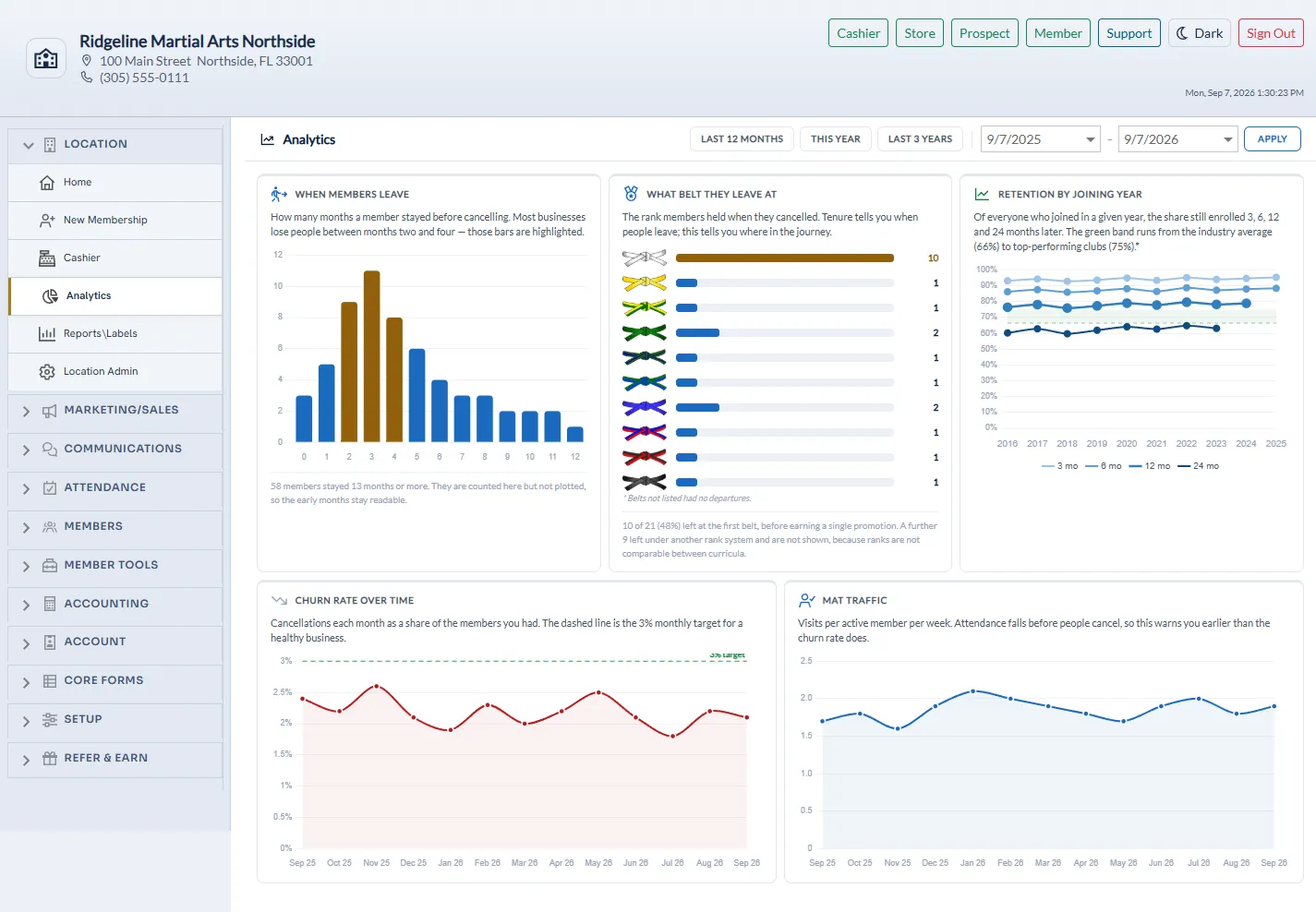
Cohort retention curves
Of the members who joined in March, how many are still here?
Each intake month is followed as its own group, month by month, so you see the shape of the decay rather than a single number. Two businesses with identical member counts can be on completely different trajectories, and this is the only view that shows it.
Tenure at cancellation
How long do members last before they leave?
A median, measured across everyone who has ever cancelled. It tells you where in the lifecycle you are actually losing people — and it is the number that turns "we have a retention problem" into "we lose them at month five".
Churn as a rate
Is this month worse than last month?
A raw count of cancellations cannot be compared month to month, because it moves with the size of your roster. A rate divides by the base you started with. It is the number owners actually quote to each other, and the one most platforms do not compute.
Lifetime value per member
What is a member actually worth, by program and by Location?
Tenure multiplied by what they pay, split the ways you run the business. It changes what a lead is worth: a source that produces members who stay two years is worth paying more for than one that produces twice as many who leave by month four.
First-90-day at-risk
Who is slipping, while there is still time?
The first ninety days are where the industry loses people, and attendance thins out well before anyone cancels. Flagging the drop-off while the member is still enrolled is the difference between a phone call and an exit interview.
The page itself
This is what Analytics looks like
Why this is hard to copy
These reports are made of history
None of this is a clever algorithm. It is arithmetic on data that has to already exist. A platform holding two years of shallow records cannot tell you which lead source produced members who are still training at twelve months, however many screens it ships — the answer is not in there to be found.
Black Belt CRM has been running membership businesses since 2011, and it keeps the whole record: every status change, every promotion, every attendance mark, every payment. The reports above are what that is for.
Want a rough figure before you look at any of this? Work out what churn is costing you — two numbers, no sign-up.
See it against your own numbers
Thirty days, no card and no contract. Every feature is switched on from the first day, including these, so what you evaluate is what you keep. From $39 a month.